



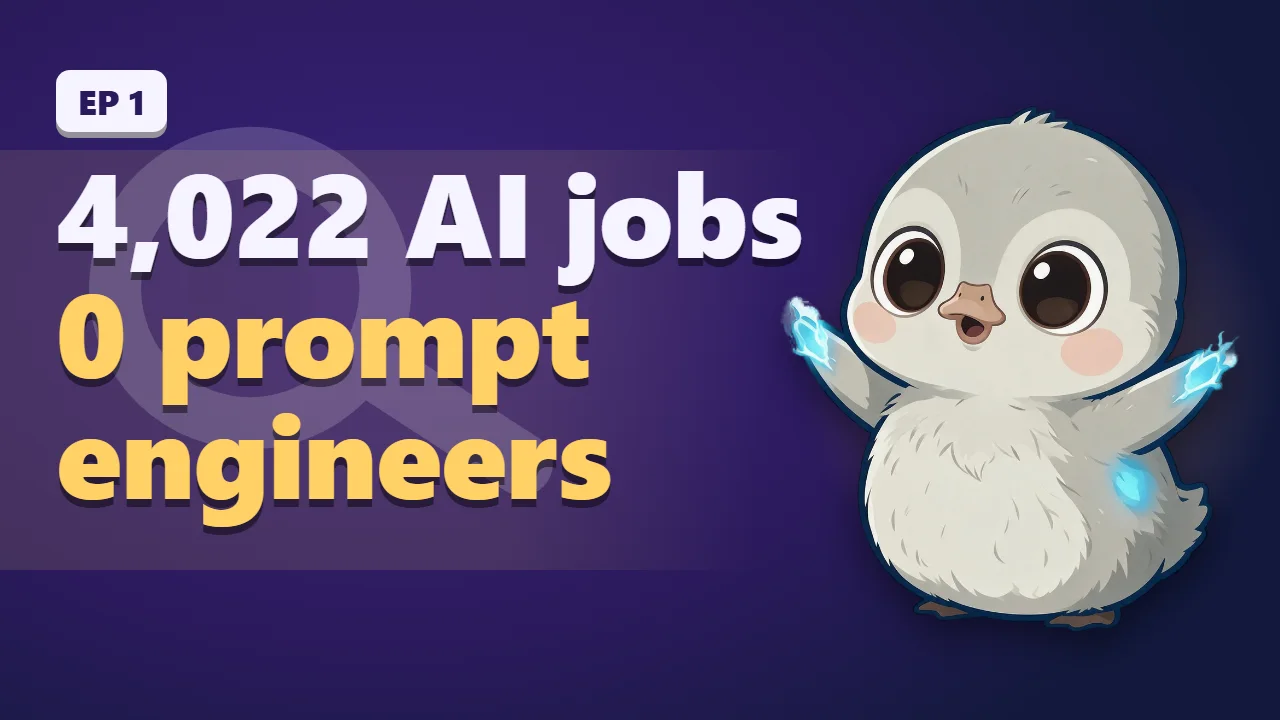
“Will AI take my job?” and “How do I get into AI?” are the questions we hear most. Instead of guessing, on 9 October 2026 we pulled 4,022 job listings from 14 mostly US AI companies, plus 293 posts from 7 Chinese companies, and read what they ask for. Counts below are mentions, not requirements, and pay is the median of posted base ranges, not real salaries.
Who is hiring
The largest groups were deployment and solutions roles (728), sales (649), AI engineers (159), research (145) and product managers (123). “Prompt engineer” appeared in 0 of 4,022 titles, yet prompt engineering is mentioned in 33% of AI-engineer listings. Evaluation shows up everywhere: in 71% of research posts, 68% of ML-engineer posts and 66% of AI-engineer posts. The posted base range for AI engineers had a median of $220K–$385K, against a US median of $135,980 for software developers. At Anthropic, 14 of 643 posts mention a PhD; in the China sample, 55% ask for at least a bachelor's degree.
What the jobs actually involve
- AI engineer (159 posts): agents 72%, evals 66%, LLMs 55%, TypeScript/JavaScript 52%, Python 49%, retrieval (RAG) 42%. Fine-tuning appears in only 7.5%, PyTorch in 3%. In 73 Chinese posts, agents reach 93%.
- Forward deployed engineer: of 728 deployment and solutions posts, 170 carry the title. They mention customer-facing work (80%), communication (57%) and ambiguity (31%), with a posted median of $182K–$254K.
- Evaluation engineer: only 23 listings carry the title, and they hide three different jobs: research evals, platform evals and safety/risk. When we hand-checked our own keyword counter, 30 of 30 flags were real mentions but only 15 were real duties. A correct number can still mislead.
Four kinds of AI work
Behind the titles sit four kinds of work: building frontier models (the rarest), applied statistics on small data, classic machine learning on business data, and products built on foundation models, from prompts and retrieval to tools, evals, cost, guardrails and monitoring. Inside a frontier lab there are nine kinds of “rooms”, including the little-known data researcher. Serving, evaluation, environments and data engineering can largely be learned from outside; kernels and distributed training are hard, and pre-training research is hardest. A portfolio is not a hiring guarantee.
That matches our own work: we build the ring around the model rather than the model itself, starting from a ready-made model and writing down every assumption instead of deciding it silently in code. Three habits transfer to any of these jobs: build the data layer first, know the noise floor, and measure.
Watch the episodes
- How AI Is Built, Ep 3 · The 4 Kinds of AI Jobs
- How AI Is Built, Ep 4 · Who Works at an AI Lab? Every Job, Room by Room
- Every AI Job, Ep 1 · I Analysed 4,022 Job Listings. Who Is Hiring?
- Every AI Job, Ep 2 · AI Engineer: What the Job Is Really Like
- Every AI Job, Ep 3 · Forward Deployed Engineers
- Every AI Job, Ep 4 · AI Evaluation Engineer: Is the Score Real?