




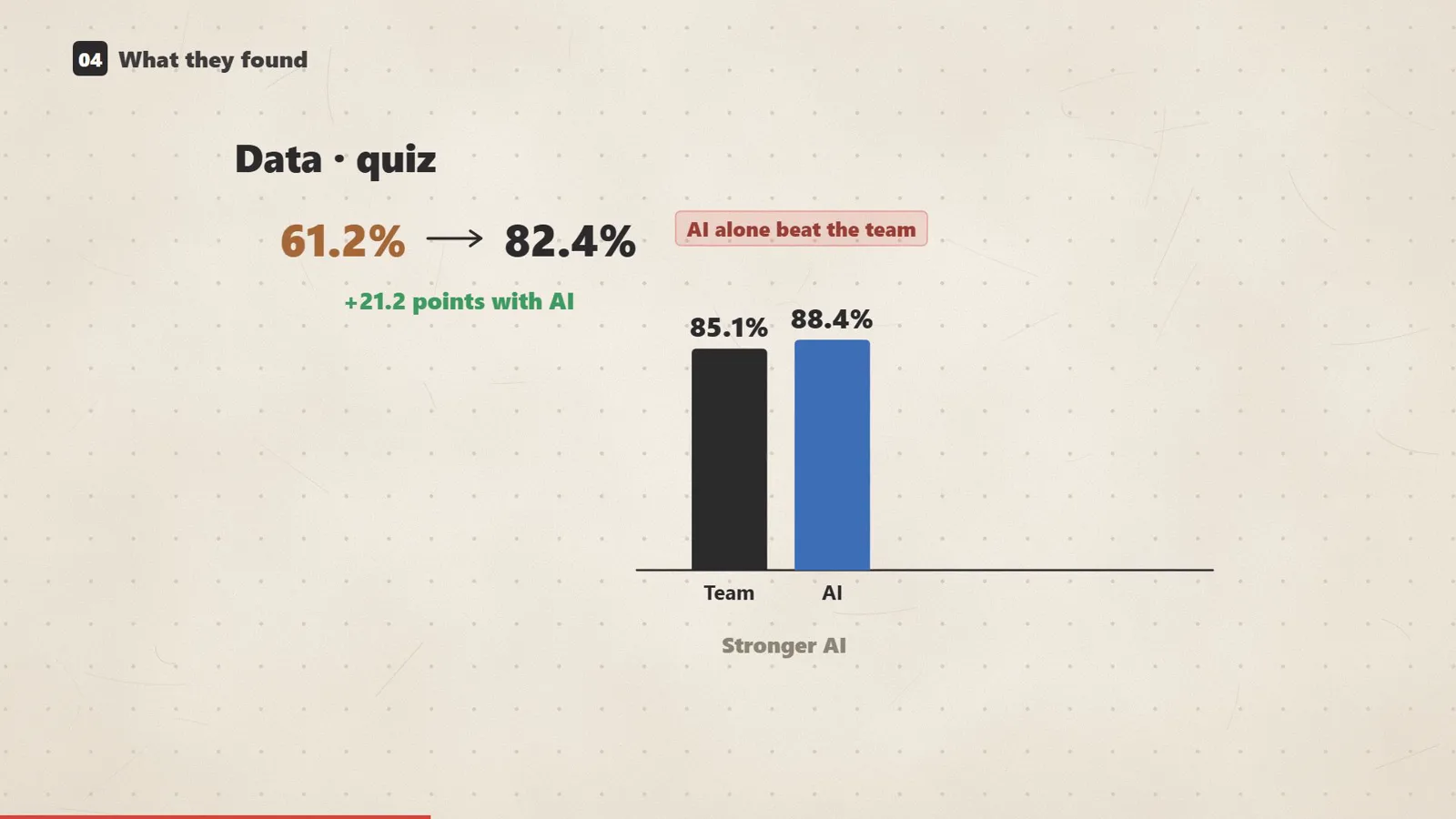
In a new study, people answered quiz questions alone, then with an AI helper. With the stronger AI, GPT-4o, people working with the AI got 85.1% right; the AI alone got 88.4%; people alone, 60%. The AI helped, yet the team trailed the AI alone. Part of the authors' explanation is shared evidence: when an AI reads the same material as you, its agreement can feel like a second opinion but may be the same opinion counted twice.
What the study did and found
AI-Assisted Classification under Correlation Neglect and Trust is by Kong, Lyu, Amin, Bennouna, Huttenlocher and Ozdaglar of MIT and Northwestern University (arXiv 2611.05870, 4 November 2026). It is a preprint; we could not verify its peer-review status. It combines a maths model, in which a person and an AI each hold evidence and some is shared, with a re-analysis of an earlier quiz study, ChatBench: 315 online crowd workers, 389 questions in maths, physics and moral reasoning, 2,199 paired answers, each person given one AI. No new data. A quiz, not a workplace.
The theory: if a person counts shared evidence twice (correlation neglect), "a more capable AI can make the team less accurate"; a careful person who knows what is shared does at least as well as either side alone. The data: AI help lifted people from 61.2% to 82.4%. With the smaller AI, team and AI were about tied. The AI-alone score is an average over many tries, not exactly the answer each person saw. The clearest finding points the other way: by the authors' estimate, people gave the AI about a quarter of the weight a careful combiner would. The authors warn their numbers may not carry over to medicine or hiring.
How strong the evidence is
- Accurate: a cited lab study found many people "double-count" linked information. But there the links were visible, and the paper's own data do not pin down how much double counting happens with AI.
- Stretched: a 2024 review of 106 experiments is cited as showing no gain or harm. It found teams beat the person alone but trailed the better of the two.
- Wrong, twice: ChatBench recruited on Prolific, not MTurk, and each person got one AI, not several, as the paper admits on page 30.
- Missing: research on algorithm aversion, which fits the under-use finding.
Verdict: solid theory, weak data. Quote the idea, not the numbers.
What our small experiment showed
We simulated made-up cases, planning the measures in advance. The person was right 70% of the time, the AI 85%, and we varied how much of the person's evidence the AI also saw. With no overlap, careful and double counting both scored 87.7%, ahead of the AI alone. At full overlap the double-counter fell to 83.6%, 1.4 points below the AI, and was about four points overconfident (five and a half when person and AI agreed). One extra independent source lifted it to 86.5% but left it about three points too sure. With an AI stronger than the person, double counting did not fall below the person alone in this setup. A check of the idea, not a re-run of the paper.
What to do with it
When an AI that read the same file agrees with you, ask what it saw or reasoned that you didn't. If nothing new, find a different source: a payment record beyond the loan form, a work sample beyond the CV, a repair invoice beyond the claim photos. Write each source next to the decision. The fix is not trusting AI more or less; it is knowing what each source actually saw.