

 Démo fonctionnelle · images d'archives, pas un site client
Vision Monitor : vos caméras existantes signalent des incidents, pas des images
Forklift speed in a store aisle: from camera to incident
Spotting a forklift on camera is something every camera brand can do. What matters is knowing, accurately, when it goes too fast or too close to a person, so that staff trust the alert and act on it. This is our working product on two cameras in a store aisle.
Cameras record, nobody watches
A warehouse-style store runs forklifts in aisles where customers walk. The cameras are already there, but nobody can watch every screen, so footage is only checked after something has gone wrong. Spotting "a person" or "a forklift" is commodity. Click the three layers to see where the real work is.
Use the ← → keys to move between steps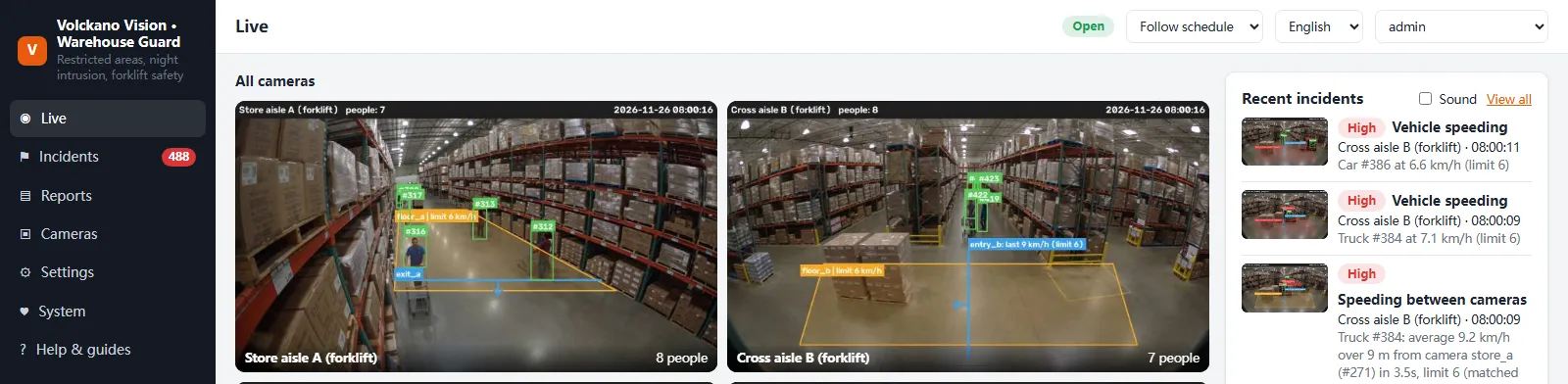
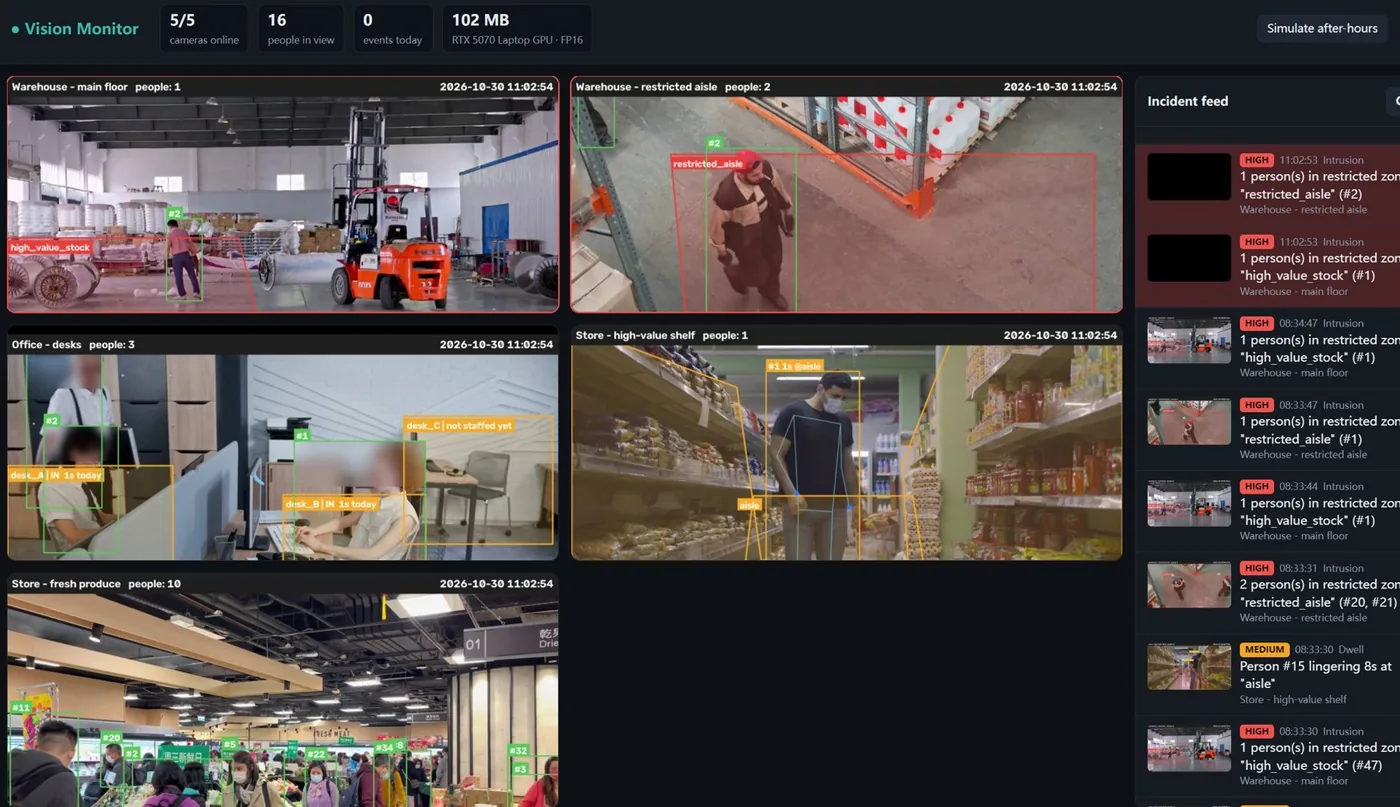
Volckano a conçu un moniteur qui surveille les caméras existantes d'un entrepôt, d'un bureau ou d'un magasin et signale les incidents.
Personne ne peut surveiller tous les écrans toute la journée; la plupart des enregistrements ne sont donc vérifiés qu'après un incident.
- Zones turn red when someone enters a restricted aisle or a high-value area
- An after-hours mode raises an incident for anyone in view
- Each incident comes with a snapshot as evidence
- A privacy option blurs heads in office views
Le personnel examine une courte liste d'incidents accompagnés de preuves, plutôt que des heures d'enregistrements.
Forklift speed is one incident. The same engine already detects the others below. Camera and vision companies install the hardware and run their own platforms; what they often lack is incident know-how tested on real use cases. We bring the rules and the experience, and fit them into their system and screens, or run ours alongside.
- ✓ Forklift or vehicle speeding
- Person too close to a moving vehicle
- Speed between two cameras
- Someone in a restricted area
- Anyone on site after hours
- Fire exit or aisle blocked
- No hard hat or vest (custom model)
- Person down
- Workstation left unstaffed
What we have learned on real sites: start with five rules, not fifteen. Each one is something that costs the owner money or hurts someone if missed, that a fixed camera can see clearly, and that goes to a person who can act within minutes.
- Person within about 2 m of a moving vehicleReady
- Anyone on site while closedReady
- Entry to the high-value cageReady
- Fire exit or escape aisle blocked for 10 minutesA person checks
- Person down in night aisles or the cold storeA person checks
Leave off at first: Hard hat and vest: needs a custom model, and a busy site gets hundreds of alerts a day.
Every new site is tuned for two weeks: days 1–3 alerts come to us only; days 4–7 we tune each rule to 2–3 alerts a day; days 8–14 the client's staff mark each alert real or false; on day 14 each rule is kept, changed or dropped.
- Accuracy: IEC 62676-6Precision and recall per scenario, graded A to D, measured on the client's own cameras during the pilot.
- People mark every alertStaff mark each alert real or false. The share that is real, rule by rule, is the accuracy we quote.
- Privacy: HK PCPD, Mainland PIPLFootage stays on site. No face recognition. People can be blurred.
- Security: OWASP ASVS L2, NIST SSDF, IEC 62443Least privilege, two-step sign-in for administrators, signed updates.
- Evidence you can trustEvery snapshot and clip has a SHA-256 fingerprint, so an edited clip is caught.
- Clear limitsIt alerts people; it does not stop machines. Stopping a machine needs IEC 61496-4 safety equipment.
- Warehouse-style stores, distribution centres and factories where forklifts and people share aisles
- Sites that already have cameras and want alerts, not more footage
- Camera and vision companies that want tested incident rules for their own platform
Commencez par un petit projet pilote.
Dites-nous la tâche. Nous vous dirons si elle vaut la peine d'être réalisée.