



 Products & Services
Data Cleaning & Training-Data Pipelines
Turn messy records and raw media into clean data. You can trace where it came from, and use it to train AI or run your business.
How it works
Bring it all in
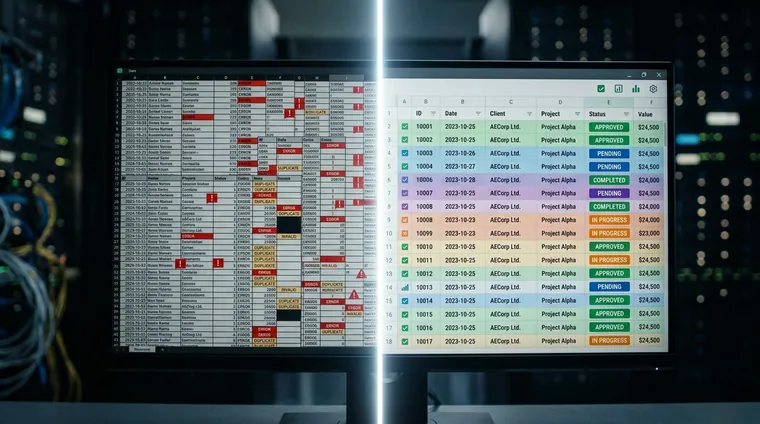
Different layouts and spellings become one standard format.
Nothing disappears silently
Duplicates move to a holding file, with a record of why.
Patterns start to show
Clean data can show seasonal patterns for buying and advertising.
Illustration only. Names and figures are made up.
Read the full description
Most data problems start before any model is trained. Records come from old spreadsheets, PDFs and supplier sheets. Each one has a different layout. People typed things in different ways, and there are duplicates. We build pipelines, which are sets of steps that bring this data in and clean it. They keep it all in one standard format.
One project was for a building-material distributor in Canada. We cleaned and standardised 20 years of sales and stock data, and removed duplicates. We also wrote logic that reads updated supplier sheets into the same format every time. It works whether the sheets come as PDF or Excel files, and whatever their layout. The clean data then showed seasonal patterns. The team could use them for buying and advertising.
We treat training data with the same care. Our own tools do not delete closed or duplicate records. They move them into a separate holding file, called a quarantine file. Our media QC tool checks AI-generated images and video against reference examples. Then it writes a signed record of where each file came from. You get clean data. You also get a clear record of what was removed and why.
What is included
Intake from messy sources
Read spreadsheets, CSV files, and PDF or Excel files with different layouts. Put them all into one standard format.
Duplicate removal and fixes
Find duplicates and entries that don't match each other. Fix them by clear rules.
Quality checks with quarantine
Rows that fail checks go to a separate file you can review. They are not thrown in the bin.
Media checks for AI training sets
Before images and video enter a dataset, we check them against approved reference examples. We make sure they are consistent.
Tracking where files came from
Record where each file came from, using hashes. A hash is a unique code worked out from a file's content. This lets the dataset be checked later.
Repeatable runs
When new files arrive, the same set of steps runs again. It gives the same format.
Key strengths
Done on real business data
We have cleaned decades of sales and stock records, not just sample files.
Nothing disappears silently
Removed rows are kept in a quarantine file. So you can check every decision.
Built for both uses
The same approach works for AI training data. It also works for the records your team uses every day.
Tools we use ourselves
We use our dataset and media QC tools on our own production work first.
What we need from you
Sample source exports, rate or cost rules, and a manually checked reporting period.
Deliverables
- A mapping of source fields, products and units
- Repeatable calculation and reconciliation reports
- Exception lists plus traceability to the source record
How it is accepted
Reconcile a held-out period against the agreed manual baseline, investigate differences and rerun the same inputs to check consistency.
Case studies
Start with one small pilot.
Tell us the task. We will say whether it is worth doing.