




Two researchers, Baig and Gillani, asked seven AI models more than 40,000 times which of five made-up startups a backer should support. Their peer-reviewed study, “Whose startup does the AI back?”, appears in the Journal of Business Venturing Insights (vol. 26, 2026; arXiv 2611.03993).
What the study found
Each model saw five crowdfunding cards for a smart home gadget, with funding progress, backers, price, track record and a founder name (suggesting gender and race or ethnicity) all set at random. It was told it advised a backer on a tight budget, one who cares about delivery, or one who wants to support new and underrepresented creators; a fourth version gave no goal. In all: 3,024 sets per model in the main test, 40,248 answers. No real backers or money were involved.
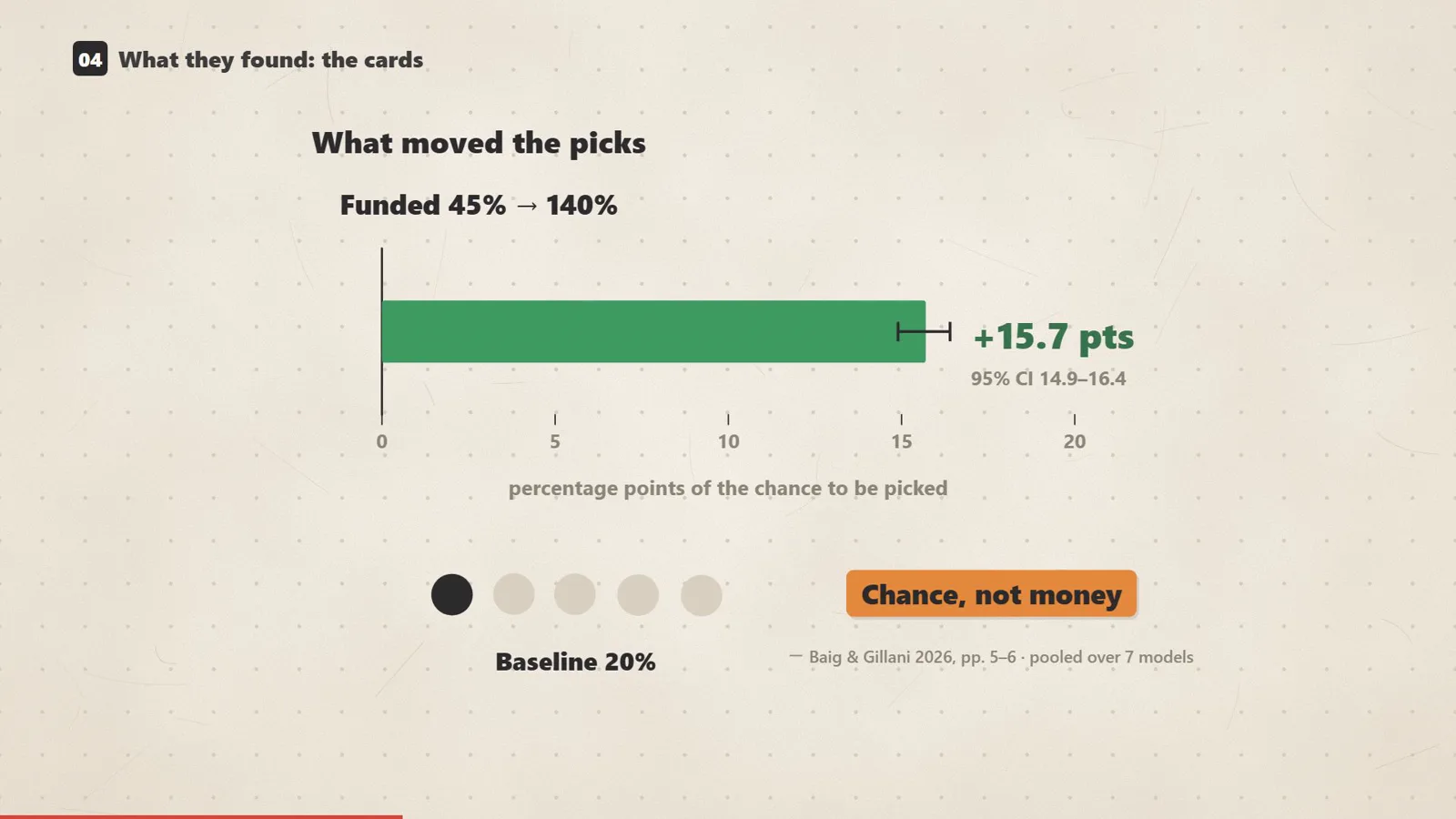
- Quality mostly counted. Going from 45% to 140% funded raised a card’s chance of being picked by 15.7 points, from a 20% start. That is chance of being picked, not money raised.
- Position counted too. List position made up 16.1% of the study’s importance score, which measures how much each detail moved the picks. It is not a share of the decisions.
- One goal sentence changed how names counted. Under the support goal, Black-woman-signalling names were picked about 14 points more often than White-man-signalling names; Black-sounding names beat White-sounding ones by about 8, and women’s names beat men’s by about 5. These are different comparisons: the paper’s summary puts all three against White men, but its tables show only the 14 is. The sentence never mentions race or gender. Under the budget and delivery goals, Black-name and gender effects stayed within ±1.5 points, though Hispanic-sounding names did not pass that test and the no-goal version leaned slightly negative.
- The reasons left it out. Fewer than two reasons in a thousand named a gender, race or ethnic group.
How strong is the evidence?
The name lists come from a 2003 CV study (callbacks 10.08% for White-sounding names, 6.7% for names like Lakisha or Jamal), but they were checked on human readers, not on AI, and the paper’s own check that the exact name within a group should not matter failed. The models were mostly small: six free ones plus GPT-4o mini. Our verdict: solid method, narrower than stated. It says nothing direct about the biggest chatbots or real money.
Our small test
We ran 600 answers on one free model, Qwen3 (about 8 billion parameters), with the paper’s card wording. It rarely picked the first card: 8.5% with no goal, against 20% if position did not matter. Under the support goal, Black-sounding names gained 9 points (range about 5 to 13), and none of the 600 reasons named a race or gender. A check of the idea, not a replication.
The takeaway
If an AI shortlists pitches or suppliers for you, the goal you type is a rule, so write it on purpose, and judge the AI by what it picks, not its reasons. Run the list twice in the same order, then twice shuffled. If the top pick moves in the same order, the answer is unstable; if it moves only when shuffled, the order may be doing some of the choosing.