




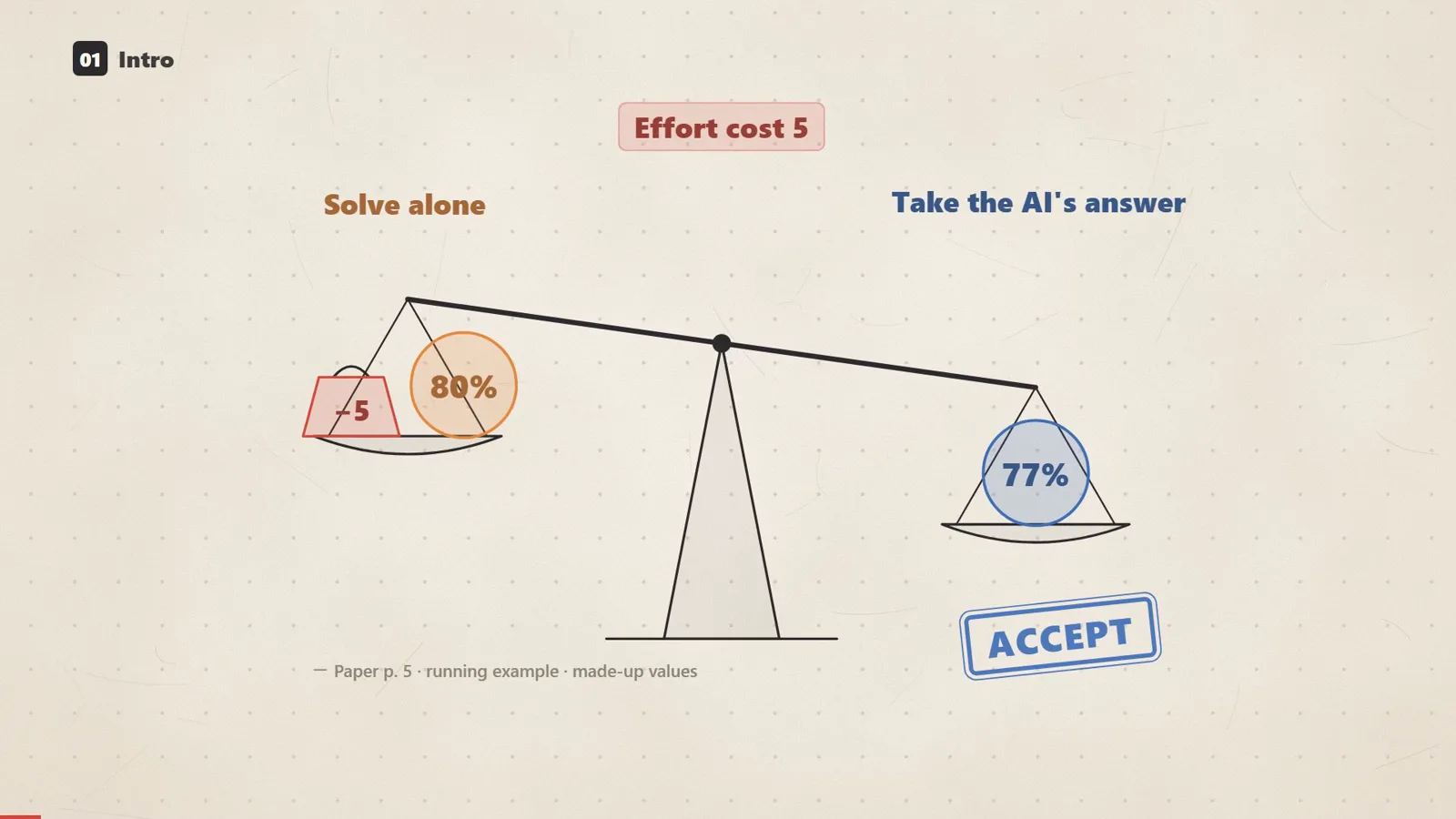
A new study asks: can using AI leave you less practiced? Its example is an expert who reviews code. Alone, she finds the bug 80% of the time; her AI assistant finds it 77% of the time. She is slightly better, but checking takes effort, and once effort is priced in, accepting the AI's answer pays more on every task. Results hold at 77% while her skill without the AI fades, unseen. These numbers are made up, from the paper's own example: a model, not a measurement of real workers.
What the study found
Today's Work, Tomorrow's Workforce: Incentivizing Learning in AI-Assisted Work, by Diener, Hendriks, Spitzer, Satzger, Holstein (KIT) and Sun (IBM Research), was posted on arXiv (2611.06346) on 4 November 2026. It is a preprint; we could not verify its peer-review status. It is a mathematical model of one worker and a line of similar tasks, drawing on two earlier studies. Solving a task alone costs effort but can raise skill a step; accepting the AI saves effort but skill can slip. In the model:
- Practice can stop when its benefits now and later don't cover its effort cost, even when the person is slightly more accurate than the AI.
- A novice at 40% with an AI at 62% can stay stuck at the lowest level (the "low-skill trap"); an expert can decline ("expert deskilling"). Output stays at the AI's level.
- A scoring rule that compares only today's accuracy calls the stuck novice's reliance appropriate.
- Paying for correct answers given without the AI can restart practice. The authors say their examples do not show how often this happens in real jobs.
How strong is the evidence?
That practice builds skill is well supported (a review of 86 studies), though it measured memory over minutes to a week, not skill at work over months. Skill fades without practice, but no source we found measures a set loss per accepted AI answer; that is an assumption. The real-world evidence is two studies: a one-hour trial where 52 programmers using AI scored 4.15 points lower on a 27-point quiz than those without (small, a preprint), and an observational study at four clinics in Poland where detection on exams without AI fell from 28.4% to 22.4%; the paper says the AI was withdrawn, but it wasn't, so this root is stretched. The paper also leaves out an earlier experiment by some of the same authors: with 180 people, a fixed bonus for correct independent answers was gamed and accuracy fell slightly (63.2% against 64.3%). Verdict: plausible idea, thin evidence.
The experiment we ran
We rebuilt the model as a simulation with the paper's made-up values: a novice at 40%, a mid-level worker at 60% and an expert at 80%, 300 tasks each, AI at 77%. With the paper's rule, all three accepted every task and results stayed at 77%, but the expert's expected skill without AI fell to about 53% and 95% of simulated experts lost at least one step. With the person answering first on every second task, results stayed at 77% and the novice rose to about 59%, but the expert still ended at about 74%. One small test is noisy: if skill falls from 80% to 70%, a 20-case test shows no drop about 29% of the time. This checks the idea; it does not confirm the paper.
One practical takeaway
Use this as a design principle, not a measured fact. On some tasks you now hand to AI, do the work yourself first, then compare. Once a month, run a small blind set of past cases without the AI and watch the trend over months, not one score.